The Korean school year is coming to a close. The students have vacation from the last week of December until the first week of February. Then the students are back at school the first two weeks of February for the graduation of the highest grade. After two weeks at school, the students have spring break. The new school year starts the first week of March.
Korean students still have classes during their vacation. There are optional language camps, and extra curricular classes. I have two weeks of vacation in January. For the rest of the students vacation I'll be teaching language camps, extra curricular classes, planning the next school year, and desk warming.
Desk warming is when showing up to work, is part of the contract, but there is nothing to do. Perhaps a desk warmer will watch a movie, facebook, read blogs, plan grad school, e-mail, or do small crafts. It's always nicer to be home, but who can complain about using work time as free time?
Wednesday, January 4, 2012


Sunday, December 25, 2011
Fresh and Clean


In Korea kids brush their teeth and clean their classroom during lunch. Brushing teeth at school is an awesome example of how schools can champion public health. I also really like the sense of responsibility and ownership that is created by having the kids clean.
Tuesday, December 13, 2011
No Shoes!


Taking off shoes when entering a building is a really important cultural piece in Korea. At my dental office, at many restaurants, in anyone's home, and at school, I take off my shoes.
Floor cleanliness is historically important in Korea because people spent a lot of time sitting on the floor. Traditionally the heating system comes from below the house, so sitting on the floor was a great way to keep warm in the winter.
Even though all the kids sit in desks, and our schools have central heating the tradition of taking off shoes is is still very strong in Korea. Normally the everyone puts their shoes in a cubby, but it is not unusual to see shoes by the door at school. The kids are supposed to wear slip on sandals inside, but everyday I see kids running around school without any socks or sandals. I worry for them in the winter, because my feet are cold even with my two pairs of socks and slippers. I suppose they're used to it.
Monday, December 5, 2011
Helping
In early October the second grade teacher at Tosan went on medical leave, and my co-teacher was asked to take over the second grade class. The principal asked a meek and nervous woman from the school library to teach English. This poor lady hadn’t taught before, and she was given very little feedback from the previous English teacher about what to do with the kids or where they were at in the curriculum. She showed up to the first class without a plan despite having a few days notice.
On the first day I gave her some pointers about where the kids were at, and what the previous teacher did with them, but I didn’t jump in to help teach. I felt a mean inside because it was clear that this woman was struggling. I could have eased her burden, but I also knew she would become reliant on me. Her reliance would have doubled my work load for the rest of the semester and possibly the rest of my contract. In early October I was still going into school 2 hours early to keep up with the work load I was then carrying. So even though it felt bad watching the substitute’s exasperation I stood by my boundaries and chose not to help teach on her first day.
The next time I saw her teach she had improved tremendously, and by the end of a few weeks she hit her stride. All my guilty feelings about not helping on the first day were completely dissolved by the end of the second day. Teaching is a great learning opportunity, and if I had intervened on the first day, I could have potentially limited a valuable experience for my colleague. I want to continue developing my understanding of when it is appropriate to help, and when “helping” is just interference that doesn’t serve me or others.
On the first day I gave her some pointers about where the kids were at, and what the previous teacher did with them, but I didn’t jump in to help teach. I felt a mean inside because it was clear that this woman was struggling. I could have eased her burden, but I also knew she would become reliant on me. Her reliance would have doubled my work load for the rest of the semester and possibly the rest of my contract. In early October I was still going into school 2 hours early to keep up with the work load I was then carrying. So even though it felt bad watching the substitute’s exasperation I stood by my boundaries and chose not to help teach on her first day.
The next time I saw her teach she had improved tremendously, and by the end of a few weeks she hit her stride. All my guilty feelings about not helping on the first day were completely dissolved by the end of the second day. Teaching is a great learning opportunity, and if I had intervened on the first day, I could have potentially limited a valuable experience for my colleague. I want to continue developing my understanding of when it is appropriate to help, and when “helping” is just interference that doesn’t serve me or others.
Wednesday, November 30, 2011
My Schools
I suppose it is time to say a little something about where I work, so here is the first in a series of posts about my schools.
I am placed at two elementary schools, Kama and Tosan. Both schools are named after the tiny towns they serve. The two schools are less than ten minutes apart by car, and each school educates less than 50 students. The biggest class I have at either school is 11 students.
I spend Tuesday, Wednesday, and Thursday at Kama where I am the main English teacher in 12 classes. Fortunately the homeroom teacher is required to co-teach with me. The homeroom teacher helps manage behavior, they translate the harder grammatical points, and they co-lead the games I plan. Monday and Friday I spend at Tosan where there is a full time English teacher. At Tosan, I am more of a classroom assistant than a teacher. I don't have to plan anything; I just show up and make sure the kids are participating. Every day I am free to plan from 2pm to 5pm.
It would be great if teachers in the United States had three hours of planning each day. At the beginning I needed every bit of this planning time, and then some for a mere 12 classes. For the first two months, I came to Kama nearly two hours early. This extra time was really necessary for organizing my classroom and being prepared for lessons. Now I'm a full month ahead in my planning, and I come in later.
My Korean co-teachers don't have as much planning time as I have either because they do much of the paperwork necessary for running a school. Since there are only 6 main teachers in each of my tiny schools, they have a much greater percentage of the paperwork than a teacher would have at a bigger school. All teachers want to be in a bigger city with bigger schools and less paperwork. Therefore the ministry of education requires each teacher to take turns working extra hard in small rural locations.
I am placed at two elementary schools, Kama and Tosan. Both schools are named after the tiny towns they serve. The two schools are less than ten minutes apart by car, and each school educates less than 50 students. The biggest class I have at either school is 11 students.
I spend Tuesday, Wednesday, and Thursday at Kama where I am the main English teacher in 12 classes. Fortunately the homeroom teacher is required to co-teach with me. The homeroom teacher helps manage behavior, they translate the harder grammatical points, and they co-lead the games I plan. Monday and Friday I spend at Tosan where there is a full time English teacher. At Tosan, I am more of a classroom assistant than a teacher. I don't have to plan anything; I just show up and make sure the kids are participating. Every day I am free to plan from 2pm to 5pm.
It would be great if teachers in the United States had three hours of planning each day. At the beginning I needed every bit of this planning time, and then some for a mere 12 classes. For the first two months, I came to Kama nearly two hours early. This extra time was really necessary for organizing my classroom and being prepared for lessons. Now I'm a full month ahead in my planning, and I come in later.
My Korean co-teachers don't have as much planning time as I have either because they do much of the paperwork necessary for running a school. Since there are only 6 main teachers in each of my tiny schools, they have a much greater percentage of the paperwork than a teacher would have at a bigger school. All teachers want to be in a bigger city with bigger schools and less paperwork. Therefore the ministry of education requires each teacher to take turns working extra hard in small rural locations.
Sunday, November 20, 2011
Trash
In a foreign country almost everything is an adventure, a puzzle, a challenge, or a mystery. That excitement drives me to travel and keeps me in constant wonder of every day activities like taking out the trash. After being in our humble new home for two days it became necessary to take out the trash. So we struck out to explore our ten story building. We found balconies, the garage, and abandoned floors, but alas no trash receptacle. At the time we only knew fellow newbies so we were at a loss.
After a few more days we crossed paths with a foreigner who had been around for a while and eagerly asked where we could throw away our trash. Our new mentor laughed; remembering how baffled they were when they first arrived. For them going around the block to the neighborhood trash site had become so normal that they forgot new comers would have trouble.
These trash sites have recycling for paper, plastic, metals, food, light bulbs, and batteries. Everything else goes into a bin labeled ‘combustible’. Fortunately someone gave us the tip to store our food waste in the freezer until we’re ready to take it out. This way it doesn’t smell up the apartment.

Sunday, November 13, 2011
Pepero Day
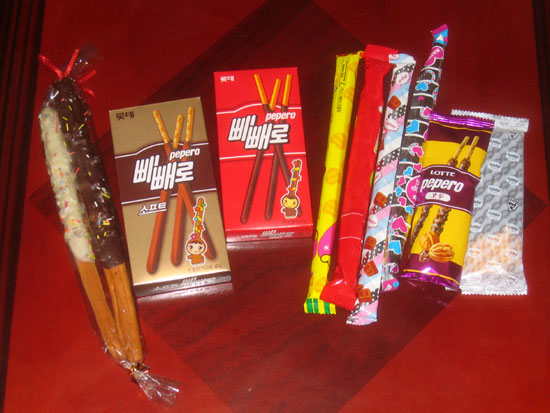
Pepero Day is a cooperate holiday at its finest. It is a holiday contrived by the company pepero which makes long prezzleish sticks covered in chocolate, there are also a few other flavors. Pepero Day follows a typical marketing scheme of convincing folks that to give and receive pepero is evidence love and friendship. The advertisements feature two cute little cartoons each with one end of the pepero in their mouth. Presumably they would kiss Lady in the Tramp style once they have eaten their half of the pepero. November 11th was cleverly chosen as Pepero Day because the elevens look like pepero sticks. This November 11, was all the more important because it was 11-11-11. Pepero is available all year round, but special wrappings, flavors, teddy bears, etc make an appearance for the holiday. My co-teacher happily told me that her boyfriend gave her a really long pepero with a nice note.
Everyone is well aware of the corporate nature of Pepero Day, but they still participate because it’s fun, and it really does make friends. I brought 20 boxes to my school, and I gave them to everybody from the lunch ladies to the principal. The lunch ladies and the cleaning lady appreciated the pepero the most. Unfortunately, the lunch ladies and the cleaning ladies are the most underappreciated people at school. (rise up working class!)
I had a big win with pepero day, because the school I taught at that day doesn’t love me very much. I’m sure they love me more now. I worried that I ruined the love I earned because I was half a minute late to class after lunch on Pepero Day. One of my third graders met me on the stairs and said, “Oh, Jamie! Jamie Teacher!!!.” Then he turned on his heels and tore up the stairs screaming “Ya! Jamie Teacher! Ya! Ya!”
In Korean “Ya.” Can mean anything from affection to “sit down and shut up!” Tone and timing is critical when determining the meaning of “Ya.” Since my student was screaming, and running, I was certain that it meant “She’s late!!!”
I was much relieved to be completely ambushed by 8 third graders waving pepero in my face. I collected my pepero with smiles and thank yous, but it was really important to them that I eat it. One student showed me the ropes by saying, “teacher!” and then he ate one with wide eyes in a very exaggerated fashion. The students were much impressed when I demonstrated that I understood. Hahaha! Then when my co-teacher showed up (after me) they gave her a similar, but lower key, welcoming.
All in all I received a lot of pepero from the kids, so I felt pretty special.
Subscribe to:
Posts (Atom)
